

Altaviva: A New Long-Term Treatment for Urge Incontinence
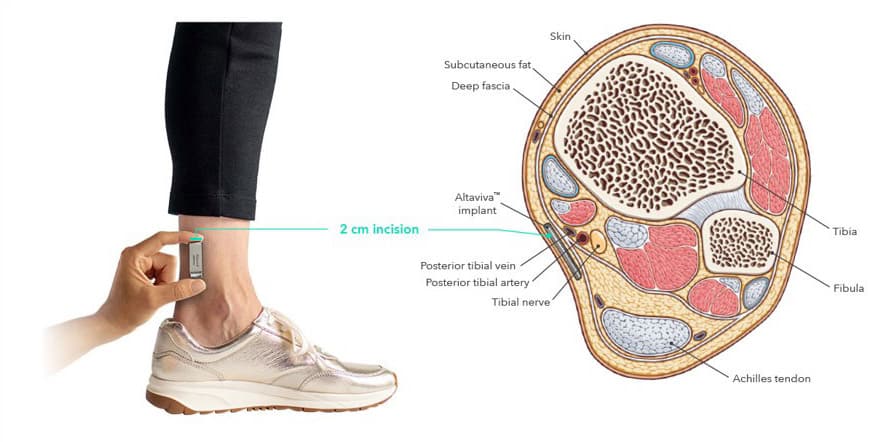 If you frequently have trouble making it to the bathroom in time, you have a couple of things in common with tens of millions of people: you might have urge urinary incontinence, and a treatment plan might exist right near your ankle.
An estimated 40% of all U.S. women (68.7 million) and 30% of U.S. men (50.5 million) experience urge incontinence at some point in their lives. That’s roughly 119 million people experiencing a sudden, intense urge to urinate that is difficult to control.
Untreated, urge incontinence can create a heavy toll: social isolation, anxiety, lack of sleep, and sexual dysfunction all are linked to incontinence, according to the National Library of Medicine.
Yet few people seek treatment for urge incontinence, often due to embarrassment, shyness, or believing it is a normal part of aging. Yet many treatment options are available. When lifestyle adjustments and medications do not alleviate the symptoms, alternative medical innovations, including a new-to-market medical device called Altaviva, approved by the FDA in September 2025, can help.
This is where your ankle comes in. But first, you should understand the symptoms and causes of urge incontinence.
Urge Incontinence Differs from Other Bladder Control Issues
While urge incontinence is common, many people misunderstand the condition because so few patients talk about it. For example, many might not know that urge incontinence is one of several bladder control issues. The other forms of urinary incontinence are stress incontinence and overflow incontinence.
It’s important to know the difference. Here is how each is distinguished:
- Stress incontinence occurs when physical strains such as coughing, sneezing, or exercising apply pressure to the bladder and unexpectedly, urine pushes out. It is caused by weak pelvic floor muscles or a weak sphincter (muscle) that controls urine flow.
- Overflow incontinence is characterized by constant dribbling, the result of the bladder not emptying properly and therefore filling up more quickly.
- Urge incontinence is a sudden and intense need to urinate, even very small amounts, due to the bladder involuntarily contracting. Often, those with urge incontinence have trouble reaching the bathroom in time.
Urge Incontinence Explained: Underlying Causes and Symptoms
Urge incontinence is not itself a disease, but rather a symptom of an underlying condition, such as bladder stones, kidney disease, or a urinary tract infection. But in many cases, it signals a communication malfunction from the sacral nerve at the base of the spine, which tells the bladder when it’s time to go.
When this misfire occurs, the muscle surrounding the bladder spasms, even when the bladder is not full, overriding your ability to feel and respond to the need to urinate.
If you suspect you have urge incontinence, you will experience these common symptoms:
- the frequent and immediate need to urinate
- waking up repeatedly overnight to use the restroom (nocturia)
- trouble holding in urine (and reaching the bathroom in time)
- leaking urine unexpectedly
Innovative Therapy Represents a Significant Advancement
As more people learn about and seek a doctor’s care for urge incontinence, more research is spearheaded to treat it. For years, the standard medical approaches for urge incontinence included medication, bladder retraining, biofeedback, nerve stimulation, or surgery.
In 2025, the FDA approved a new, minimally invasive nerve-stimulation therapy, called Altaviva. It is the latest innovation in a treatment pathway called tibial neuromodulation. (Altaviva’s developer, Medtronic, introduced the first neuromodulation device for the bladder more than three decades ago.)
This system involves a slim battery-powered device, about the size of a small flash drive, implanted just under the skin near the ankle at the base of the tibial nerve. The tibial nerve travels up the leg and connects to the sacral nerve, which sends signals to the brain that control bladder function.
The Altaviva device dispatches gentle electrical pulses to the tibial nerve and then the brain through this communication pathway. These pulses help restore communication between the bladder and the brain, with the aim of reducing sudden urges to urinate and leaks.
Benefits, Side Effects, and Success Rates of Altaviva
Altaviva differs from standard tibial nerve stimulation (TNS) approaches in that it is a one-time treatment; it does not require weekly or monthly visits to re-administer stimulation. It also works without external wires or hardware thanks to its battery, which is designed to deliver therapy for up to 15 years. (The device is charged annually using a patient-controlled remote/recharger.) As such, it is considered a long-term solution for patients who do not respond to other treatments.
The procedure is performed in an outpatient setting and does not require sedation or general anesthesia. The therapeutic pulses activate the same day.
Success rates are encouraging. Twelve months after clinical trials, 80% of Altaviva patients said their conditions improved, and 61% reported a 50% or better reduction in urge incontinence events.
The most common side effects include mild pain near the site of the implant, light tingling, numbness, and infection. Serious side effects are rare, but complications other than surgery-related risks can include pain at the implant site, lower leg pain, infection, nerve injury, and/or technical or device problems.
Is Altaviva the Right Urge Incontinence Treatment for You?
If you are among the millions of people experiencing the symptoms of urge incontinence, talk to your urologist before making any treatment choices. Different people do well with different approaches. Altaviva might be the right therapy for you, but you could benefit from other approaches first.
You can learn more about the Altaviva System on our website as well as visit our Tibial Nerve Stimulation website. To schedule an appointment to discuss the best treatment options for you, visit our website.
